
The answer
The IDF is operating in Lebanon to break Hezbollah's military power, empty the southern border region, seize strategic depth, and impose an Israeli line of control reaching toward the Litani.1 Hezbollah resumed large-scale attacks from Lebanon on 2 March while Israeli forces still held positions north of the Blue Line and Israel continued to strike and fly over Lebanon.2 That attack opened the current phase. Israel's Zionist territorial project shaped the scale, geography, and political use of the campaign that followed.
Finance Minister Bezalel Smotrich demanded that the Litani become Israel's border.3 Defence Minister Israel Katz announced a military “security zone” reaching the same river, ordered accelerated destruction of Lebanese homes, and said residents would remain excluded until Israel declared its northern communities safe.1 By late August, entire neighbourhoods had been wiped out and UNIFIL described organized Israeli demolitions as apparently systematic.4 Approximately 350,000 people still could not return home at the end of that month.5
Elias Konsol fled Alma al-Shaab with his neighbours and UNIFIL peacekeepers. He told the Associated Press that there had been no weapons or Hezbollah fighters in his Christian border village, yet its residents were ordered out. “We don't know if we will see our homes and village again,” he said.1
The public explanation
On 8 March 2026, the Israeli military published a short answer to the question in this article's old slug. Hezbollah, it said, had joined Iran's war six days earlier by firing rockets and drones at Israel. The IDF said it had answered with roughly 700 munitions against 600 targets, was attacking "exclusively" terrorist targets, and had established positions in southern Lebanon as a form of forward defence.6
Hezbollah's attack placed Israeli civilians at risk and supplied the government's immediate justification. It did not begin from peace or a completed Israeli withdrawal. The military's account starts the clock after the occupation positions, ceasefire-period strikes, airspace violations, and civilian deaths described below.
The date the IDF chose
The IDF starts the clock on 2 March. The UN record from the preceding months describes the conditions Israel leaves outside the frame.
During the four months before the new war, UNIFIL detected 242 projectile trajectories crossing the Blue Line from south to north, from Israel into Lebanon, and none going north to south. The UN Secretary-General reported repeated Israeli air strikes, at least 134 civilians killed by Israeli operations in Lebanon since the November 2024 cessation of hostilities, and no reported casualties in Israel during that reporting period. Israeli forces remained in five positions and two buffer zones north of the Blue Line, while the UN recorded 3,091 Israeli airspace violations totalling 4,682 flight hours.2
The ceasefire already contained Israeli strikes and Israeli-held territory inside Lebanon. In August 2025, the Security Council called on Israel to withdraw from the five positions and lift the buffer zones.7 Those positions remained when Hezbollah attacked on 2 March 2026.
The 2 March timeline erases more than a year of coercion carried out under the name of ceasefire. It allows every later seizure of land to appear as an emergency response detached from the land Israel already held.
What “precision” produced
By 28 August, Lebanon's Ministry of Public Health reported 4,352 people killed and 12,318 wounded since 2 March.8 These government aggregates have not undergone an independent incident-level audit, and the ministry has published no complete civilian-combatant breakdown. Even with that limitation, they describe a campaign whose violence reached across the country.
One day makes the abstraction concrete. Early accounts said that more than 300 people were killed and roughly 1,150 wounded on 8 April. Two days later, the health ministry's still-nonfinal revision put the toll at 357 killed and 1,223 wounded.9 Associated Press reporters described strikes hitting dense residential and commercial districts during the evening rush; Lebanese officials said more than 100 of those killed were women, children, or older people.10 Responsible use of the earlier 300/1,150 count requires its date, its ministry provenance, and its later revision.
A warning establishes that a warning was issued. The military still has to identify a military objective, assess expected civilian harm, and provide a route people can actually use. Amnesty International investigated three March strikes on family homes that killed 24 civilians, including 12 children. It found no evidence of a military target at the sites. Israel gave Amnesty a general account of its targeting process but no site-specific evidence answering the findings. Amnesty called for the attacks to be investigated as war crimes.11
The damage extends far beyond the death toll. By 20 April, the World Health Organization had verified 147 attacks on health care, with 100 health workers killed and 233 injured while on duty. OCHA reported that six hospitals and 51 primary-health centres were closed, while 15 hospitals and seven centres had been damaged.12 By 17 June, UNICEF reported 247 children killed and 992 injured since the war began, with more than 770,000 children experiencing heightened distress.13
Aggregate harm cannot decide the legality of every individual strike. It does make the IDF's categorical language untenable without target files and civilian-harm assessments that the military has kept from public view.
A border shaped by invasion and occupation
Israel's military presence in Lebanon reaches back decades. After a Palestine Liberation Organization attack in Israel, Israeli forces invaded southern Lebanon in 1978. Security Council resolution 425 called for their withdrawal and created UNIFIL. Israel invaded again in 1982 and reached Beirut. It later withdrew from much of the country but maintained an occupation zone in the south with the South Lebanon Army until the UN verified Israeli withdrawal in May 2000.14
During the 1982 occupation of west Beirut, Lebanese Phalangist forces massacred civilians in the Sabra and Shatila refugee camps. Contemporaneous UN observers reported the bodies of civilian men, women, and children.15 Israel's own Kahan Commission found Ariel Sharon personally responsible for disregarding the danger of revenge and bloodshed; the commission's recommendation forced his removal as defence minister.16 Israeli “security zones” in Lebanon have a history: mass displacement, proxy forces, prisons, village destruction, and an occupation that lasted until 2000.
The 2006 Israel-Hezbollah war produced Security Council resolution 1701. It called for a full cessation of hostilities, Israeli withdrawal in parallel with deployment of the Lebanese army and UNIFIL, respect for the Blue Line, and an area south of the Litani free of armed personnel and weapons other than those of the Lebanese state and UNIFIL.17 Neither Israel nor Hezbollah can plausibly claim faithful implementation.
After 7 October 2023, Hezbollah opened a cross-border front in declared support of Gaza. Its campaign hit military targets and also killed civilians. Amnesty investigated three 2024 attacks using unguided rockets that killed eight civilians and injured at least 16 in Israel, and concluded that the weapons could not be accurately directed at specific military targets.18 Those attacks were unlawful. Israel remained bound by the same rules of distinction and proportionality in every strike it launched in response.
Ceasefire without withdrawal
The November 2024 cessation agreement required Hezbollah and all other armed groups in Lebanon to stop operations against Israel. It also required Israel to stop offensive military operations in Lebanon by land, air, and sea, and provided for Israeli withdrawal as Lebanese state forces deployed in the south, on a timetable not to exceed 60 days.19
The agreement failed on both sides, but not symmetrically in the period immediately before March 2026. The Secretary-General reported that the Lebanese Armed Forces had deployed more than 9,000 personnel south of the Litani and had removed most unauthorized sites referred to it by UNIFIL. Israel still occupied positions, flew over Lebanon, and carried out strikes. Hezbollah retained weapons and the capacity to start the new round.2
A June 2026 US-Israel-Lebanon framework assigns responsibility for Lebanon's security and defence, and authority over war and peace, exclusively to the Lebanese state. It calls for non-state armed groups to disarm.20 The agreement was reached while Israeli forces held Lebanese territory, and it makes their withdrawal conditional on disarmament benchmarks. Land seized by force becomes leverage: Israel controls the ground while retaining a say over whether Lebanon has done enough to earn its return.
The war remained active at the end of August. On 15 August, Israeli strikes in southern Lebanon killed 11 people, including three children; Israel said it hit Hezbollah infrastructure, while Lebanon's prime minister said responsibility for military infrastructure belonged to the state.21 On 27 August, UNIFIL reported Hezbollah drone attacks and Israeli strikes. Its spokesperson said entire neighbourhoods had been wiped out by air strikes, projectiles, and organized Israeli demolitions, and described the damage as apparently systematic.4 Four days later, approximately 350,000 people remained displaced, according to the UN humanitarian office, with tens of thousands still living in collective shelters.5
The UN human rights chief has called for an end to the occupation and demolitions and warned that some conduct could amount to war crimes.22 Courts will decide criminal responsibility. Meanwhile, Israeli forces continue to determine who can return, which buildings survive, and where the effective line of control runs.
Resistance under occupation
Israel uses “terrorist” to collapse attacks on soldiers, attacks on civilians, armed resistance, and indiscriminate fire into one category. The distinction determines who may lawfully be attacked. International humanitarian law requires every party to direct attacks at military objectives and prohibits attacks on civilians and indiscriminate attacks.23
Israeli combat troops occupying a Lebanese village are military targets; medical personnel, anyone hors de combat, and civilians remain protected. Hezbollah fighters taking direct part in hostilities are military targets. Lebanese families remain civilian even when Hezbollah operates nearby. The same rules apply across the border.
Hezbollah's inaccurate rocket attacks on populated areas violated those rules.18 Fighting Israeli troops holding Lebanese land belongs to a different category: armed resistance to occupation. Treating both acts as “terrorism” gives the occupying army a monopoly on legitimate violence and erases the people whose land it occupies.
The Palestinian struggle supplies the regional context Hezbollah itself invokes. The Palestinian people hold an internationally recognized right to self-determination. In 1982, UN General Assembly resolution 37/43 affirmed the legitimacy of struggles against colonial domination and foreign occupation “by all available means, including armed struggle.”24 International humanitarian law still governs the means: resistance cannot target civilians. The right being pursued does not belong to Israel to grant or withhold.
Lebanese people can dispute Hezbollah's independent power to decide when the country enters a regional war. That political dispute survives alongside a simpler fact. When Israeli troops occupy Lebanese territory, there is an occupation to resist.
The Zionist project and the borders it draws
Zionism has contained competing parties and territorial programs. The state form enforced in Palestine has a clear constitutional core. Israel's 2018 Nation-State Basic Law reserves national self-determination in the state exclusively to the Jewish people and directs the state to encourage Jewish settlement.25 Palestinian sociologist Areej Sabbagh-Khoury traces settler-colonial analysis of Zionism through the dispossession of Palestinian land and sovereignty and the recovery of Palestinians as agents of their own history.26 Anti-Zionism in this article means opposition to that system of exclusive national power and settlement at the expense of people already living on the land. It makes no claim about Jews as a people or Judaism as a religion.
The Zionist movement formally claimed territory that now lies inside southern Lebanon before Israel existed. On 3 February 1919, the Zionist Organisation asked the Paris Peace Conference for a northern boundary beginning on the Mediterranean south of Sidon and running through the Lebanese foothills. The submission also demanded arrangements protecting access to water south of the Litani for the proposed Palestine. Its eastern boundary ran near the Hejaz Railway, deep inside what became Jordan.27
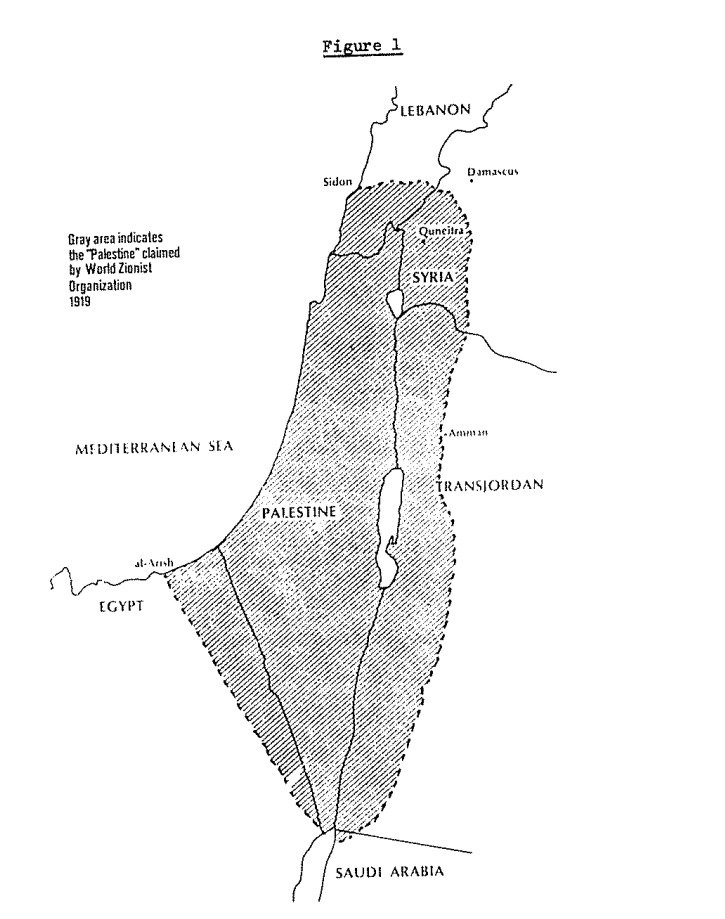
The territory claimed by the World Zionist Organization at the 1919 Paris Peace Conference. This UN reproduction shows the proposed line reaching southern Lebanon near Sidon and extending east of the Jordan River. The proposal was not adopted as an international border. Image: United Nations, 1980.28
Smotrich later supplied an explicit method for turning this ideology into territory. His 2017 “Decisive Plan” called for full Israeli sovereignty through new settlements and hundreds of thousands of settlers. Palestinians would abandon collective national claims and live under local administrations without an initial Knesset vote, accept assistance to emigrate, or face military force if they continued to resist. He called the first stage “victory through settlement.”29
This program joins demography, land, and force. Military power defeats resistance and removes people from territory; settlement and unequal law make the result difficult to reverse. This is the material process named by the settler-colonial analysis above. Israel has announced no civilian settlement phase in Lebanon. The documented sequence there currently consists of forced evacuation, open-ended displacement, demolition, military control, and a ministerial demand that the new line become Israel's border.1
“Greater Israel” carries different boundaries in different Zionist currents. No single map controls the project. The recurring practice is visible across them: conquest creates a security line; the security line becomes a proposed border; depopulated territory becomes an asset to retain, settle, annex, or trade back on Israel's terms.
In March 2023, Finance Minister Bezalel Smotrich spoke in Paris behind a podium bearing a “Greater Israel” map that incorporated modern Jordan. The event organizer supplied the graphic. Smotrich supplied the politics: during the speech he denied the existence of a Palestinian people, while holding authority in Israel's government over parts of civilian administration in the occupied West Bank.30
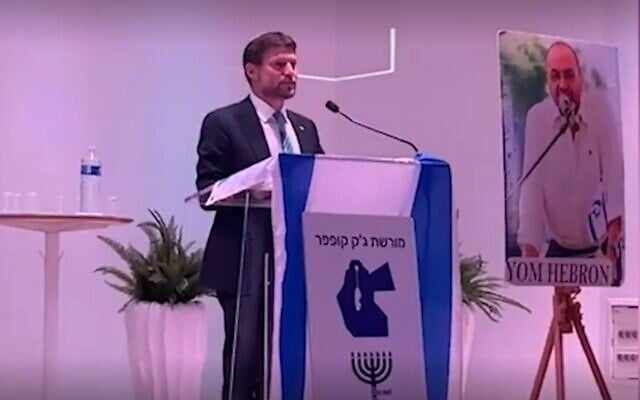
Smotrich at a private political event in Paris, 19 March 2023. The map is visible on the front of the podium. Image: Ynet video screenshot reproduced by The Times of Israel.30
In January 2025, the Israeli Foreign Ministry's official Arabic-language account published a map of the purported kingdoms of Israel and Judah in 928 BCE. The graphic placed parts of modern Lebanon, Syria, Jordan, and the occupied West Bank inside a territorial story that culminated in the establishment of the modern Israeli state. The caption presented ancient history; the evidence here is the ministry's use of that history to narrate modern state territory.31
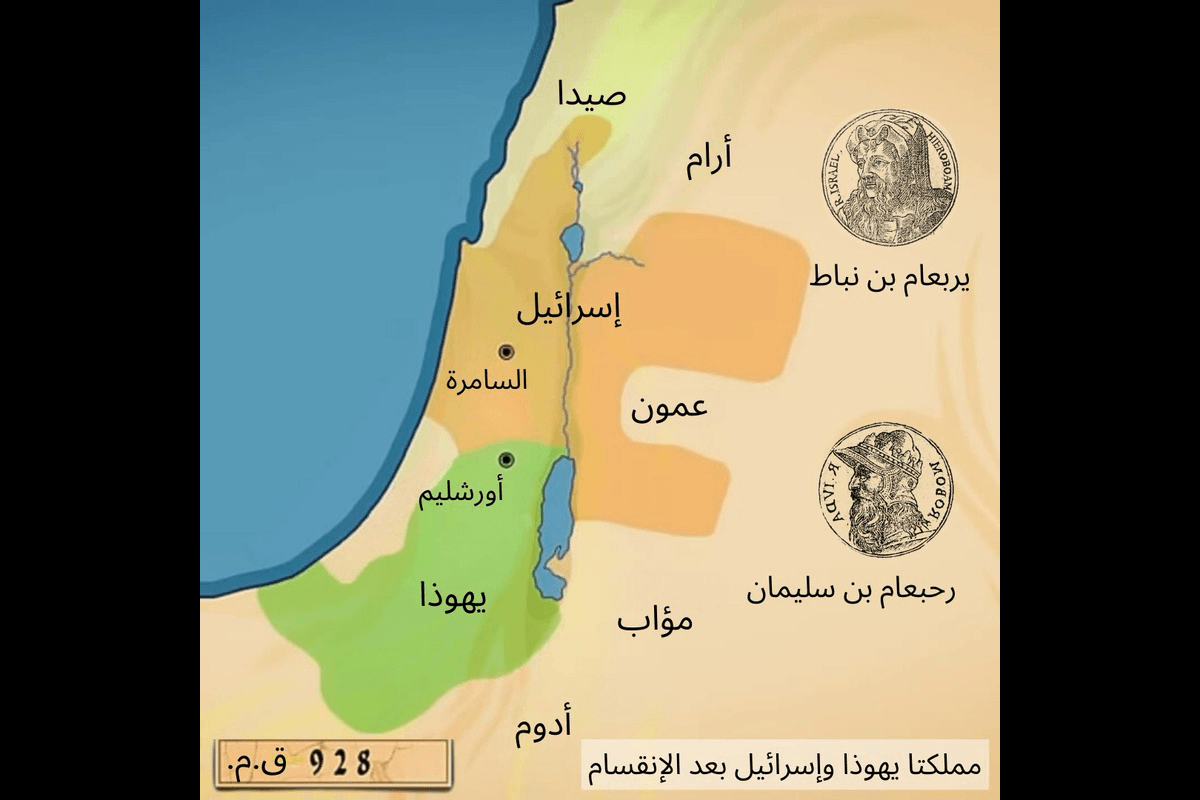
Map published by the Israeli Foreign Ministry's official Israel Arabic account on 6 January 2025. The labels describe purported ancient kingdoms in 928 BCE. Image: Israel Arabic via X; local copy preserved from a contemporary republication.31
Prime Minister Benjamin Netanyahu made the connection explicit in an August 2025 interview. After the interviewer presented an amulet described as a map of the Promised Land and asked whether he connected to the vision of Greater Israel, Netanyahu answered “very much” twice. He described his role as a “historic and spiritual” mission.32
By March 2026, the language had moved from symbolic maps to Lebanon's physical border. Smotrich told his Knesset faction: “The Litani must be our new border with the state of Lebanon.”3 On 9 April, speaking at the inauguration of a new West Bank settlement, he described political outcomes that would expand Israel's borders in Gaza, carry the Lebanon border to the Litani, and retain the summit of Mount Hermon and at least the buffer zone in Syria.33
Defence Minister Israel Katz supplied the military program. He announced a “security zone” reaching the Litani, ordered accelerated destruction of Lebanese homes in contact-line villages, and said the campaign would follow the model applied to Beit Hanoun and Rafah in Gaza. Residents would remain excluded until Israel declared its northern communities safe.1
These statements were made by the finance minister, a Security Cabinet member, and the defence minister while the army was carrying out the policy they described. Villages were emptied and homes destroyed.1 Israel bombed bridges across the Litani and said its military would control the remaining crossings.1 The June framework then made withdrawal from seized land conditional on disarmament benchmarks.20 The expansionist constituency did not have to infer a hidden objective from diplomatic language. Powerful ministers told it that victory should change the border.
What is at stake
Palestinian settler-colonial scholarship identifies dispossession, exclusive sovereignty, and settlement as linked mechanisms of Zionism in Palestine.26 Israel has announced no civilian settlement phase in Lebanon. The documented sequence there is forced evacuation, open-ended displacement, demolition, military control, and a ministerial demand to move the border.1
For Lebanon, Smotrich demanded a border at the Litani. Katz ordered a military security zone reaching the same river. The June framework then made withdrawal depend on conditions negotiated while Israel occupied Lebanese land.20
The Lebanese people have the right to resist foreign occupation.24 Hezbollah attacks directed at Israeli combat forces holding Lebanese territory belong to armed resistance; its attacks on civilians and its indiscriminate rocket fire remain unlawful.18 The same distinction protects Palestinian resistance while prohibiting attacks on civilians.
This is a war over who will live in southern Lebanon and who gets to draw its border. Israel has the military capacity to redraw that border by force, powerful Zionist ministers demanding that it do so, and a state history of turning “temporary” security zones into facts imposed on other people's land.14 That is why the IDF is in Lebanon.
Footnotes
-
Kareem Chehayeb and Julia Frankel, Lebanese fear another occupation as Israel threatens to use Gaza tactics in the south (2026-03-26). Associated Press. Source type: wire-report. ↩ ↩2 ↩3 ↩4 ↩5 ↩6 ↩7 ↩8
-
United Nations Secretary-General, Implementation of Security Council resolution 1701 (2006), 21 October 2025 to 20 February 2026 (S/2026/160) (2026-03-11). United Nations Security Council. Source type: primary-document. ↩ ↩2 ↩3
-
Times of Israel staff and agencies, Smotrich says Litani River should be Israel's new border with Lebanon (2026-03-24). The Times of Israel. Source type: news-report. ↩ ↩2
-
United Nations Interim Force in Lebanon, UNIFIL update (2026-08-27). United Nations Office at Geneva. Source type: institutional-statement. ↩ ↩2
-
Abby Sewell, School starts soon in Lebanon but thousands still shelter in them during war (2026-08-31). Associated Press. Source type: wire-report. ↩ ↩2
-
IDF Spokesperson, Why the IDF is Operating in Lebanon Today (2026-03-08). Israel Defense Forces. Source type: government-statement. ↩
-
United Nations Security Council, Resolution 2790 (2025) (2025-08-28). United Nations Digital Library. Source type: legal-document. ↩
-
Lebanese Ministry of Public Health, Updated total toll of the aggression: 4,352 martyrs and 12,318 wounded (2026-08-28). Lebanese Ministry of Public Health. Source type: government-statement. ↩
-
Lebanese Ministry of Public Health, The cumulative death toll from the aggression exceeds 1,900 martyrs and the toll from April 8th is expected to rise (2026-04-10). Lebanese Ministry of Public Health. Source type: government-statement. ↩
-
Abby Sewell, What to know about the ongoing war between Israel and Hezbollah in Lebanon (2026-04-09). Associated Press. Source type: wire-report. ↩
-
Amnesty International, Lebanon: Israeli attacks killing children, wiping out families must be investigated as war crimes (2026-07-09). Amnesty International. Source type: ngo-report. ↩
-
United Nations Office for the Coordination of Humanitarian Affairs, Lebanon: Flash Update No. 19 (2026-04-21). OCHA Lebanon. Source type: humanitarian-report. ↩
-
UNICEF Lebanon, Statement by UNICEF Country Representative in Lebanon Marcóluigi Corsi on the ongoing suffering of children (2026-06-17). UNICEF. Source type: institutional-statement. ↩
-
United Nations Interim Force in Lebanon, UNIFIL background. United Nations Peacekeeping. Source type: reference-page. ↩ ↩2
-
United Nations Secretary-General, Report of the Secretary-General on the situation in the Beirut area (S/15400) (1982-09-25). United Nations Security Council. Source type: primary-document. ↩
-
The Knesset, Ariel Sharon. The Knesset. Source type: reference-page. ↩
-
United Nations Security Council, Resolution 1701 (2006) (2006-08-11). United Nations Digital Library. Source type: legal-document. ↩
-
Amnesty International, Israel: Hezbollah's use of inherently inaccurate weapons to launch unlawful attacks violates international law (2024-12-20). Amnesty International. Source type: ngo-report. ↩ ↩2 ↩3
-
Governments of Israel and Lebanon, Announcement of a Cessation of Hostilities and Related Commitments on Enhanced Security Arrangements and Toward the Implementation of UNSCR 1701 (2024-11-26). PA-X Peace Agreements Database. Source type: primary-document. ↩
-
Governments of the United States, Israel and Lebanon, Trilateral Framework Between the United States, Israel, and Lebanon (2026-06-26). US Department of State archive via GlobalSecurity.org. Source type: primary-document. ↩ ↩2 ↩3
-
Bassem Mroue, Israeli airstrikes on southern Lebanon kill 11 people in another test to truce (2026-08-15). Associated Press. Source type: wire-report. ↩
-
Kareem Chehayeb, UN human rights chief says Israel must end occupation and house demolitions in Lebanon (2026-07-27). Associated Press. Source type: wire-report. ↩
-
International Committee of the Red Cross, Frequently asked questions on the rules of war (2022-10-19). International Committee of the Red Cross. Source type: reference-page. ↩
-
United Nations General Assembly, Importance of the universal realization of the right of peoples to self-determination (A/RES/37/43) (1982-12-03). United Nations. Source type: legal-document. ↩ ↩2
-
The Knesset, Basic-Law: Israel — The Nation State of the Jewish People (2018-07-19). The Knesset. Source type: legal-document. ↩
-
Areej Sabbagh-Khoury, Tracing Settler Colonialism: A Genealogy of a Paradigm in the Sociology of Knowledge Production in Israel (2021-03-15). Politics & Society. Source type: academic-source. ↩ ↩2
-
Zionist Organisation, Statement of the Zionist Organisation regarding Palestine (1919-02-03). Paris Peace Conference; transcription hosted by Boston University. Source type: primary-document. ↩
-
United Nations Committee on the Exercise of the Inalienable Rights of the Palestinian People, The Palestine Question: A Brief History. United Nations. Source type: primary-document. ↩
-
Bezalel Smotrich, Israel's Decisive Plan (2017-09-07). HaShiloach. Source type: primary-document. ↩
-
Times of Israel staff, Smotrich says there's no Palestinian people, declares his family 'real Palestinians' (2023-03-20). The Times of Israel. Source type: news-report. ↩ ↩2
-
Israel Arabic, Post depicting the kingdoms of Israel and Judah after their division (2025-01-06). Israeli Ministry of Foreign Affairs. Source type: government-statement. ↩ ↩2
-
Times of Israel staff, Netanyahu says he's on a 'historic and spiritual mission,' also feels a connection to vision of Greater Israel (2025-08-12). The Times of Israel. Source type: news-report. ↩
-
Elisha Ben Kimon, Smotrich: We will expand our borders in Gaza, Lebanon and Syria — that is what our neighborhood respects (2026-04-09). Ynet. Source type: news-report. ↩